A Rondebosch window is not one window. It is two sashes stacked on top of each other, and the top one and the bottom one are solving completely different problems — privacy down low, heat and glare up high. Almost every disappointing blind in this suburb comes from treating the whole opening as a single rectangle. So this guide reads a window the way you build one: from the sill upward, one horizontal band at a time, ending outside the wall altogether.
The blind industry designs around a modern aluminium window: wider than it is tall, hung in a shallow plastered opening, and no more than about waist-to-head in height. Rondebosch's older housing stock does the opposite. A Victorian or Edwardian sash is tall and narrow, sits in a reveal deep enough to hold a sill board you could put a plant on, and stands in a room whose ceiling is far above the 2.4 metres a new house gives you.
That single change of proportion has consequences a catalogue never mentions. A long drop of fabric weighs more, so the tube it rolls onto has to be thicker or it will bow in the middle over time. A heavier blind needs a heavier chain, a stiffer bracket, and often a motor simply because nobody wants to haul two metres of blockout up by hand twice a day. A slat blind on a tall window carries more slats, more ladder tape and more weight in the bottom rail. None of this is exotic; it is just arithmetic that stops working if you order to a standard size.
The reveal itself deserves a second look before anything is chosen. On a hundred-year-old frame, the depth at the head and the depth at the sill are frequently not the same, and the opening is rarely dead square. That is normal and it is fixable, but only if it is measured rather than assumed.
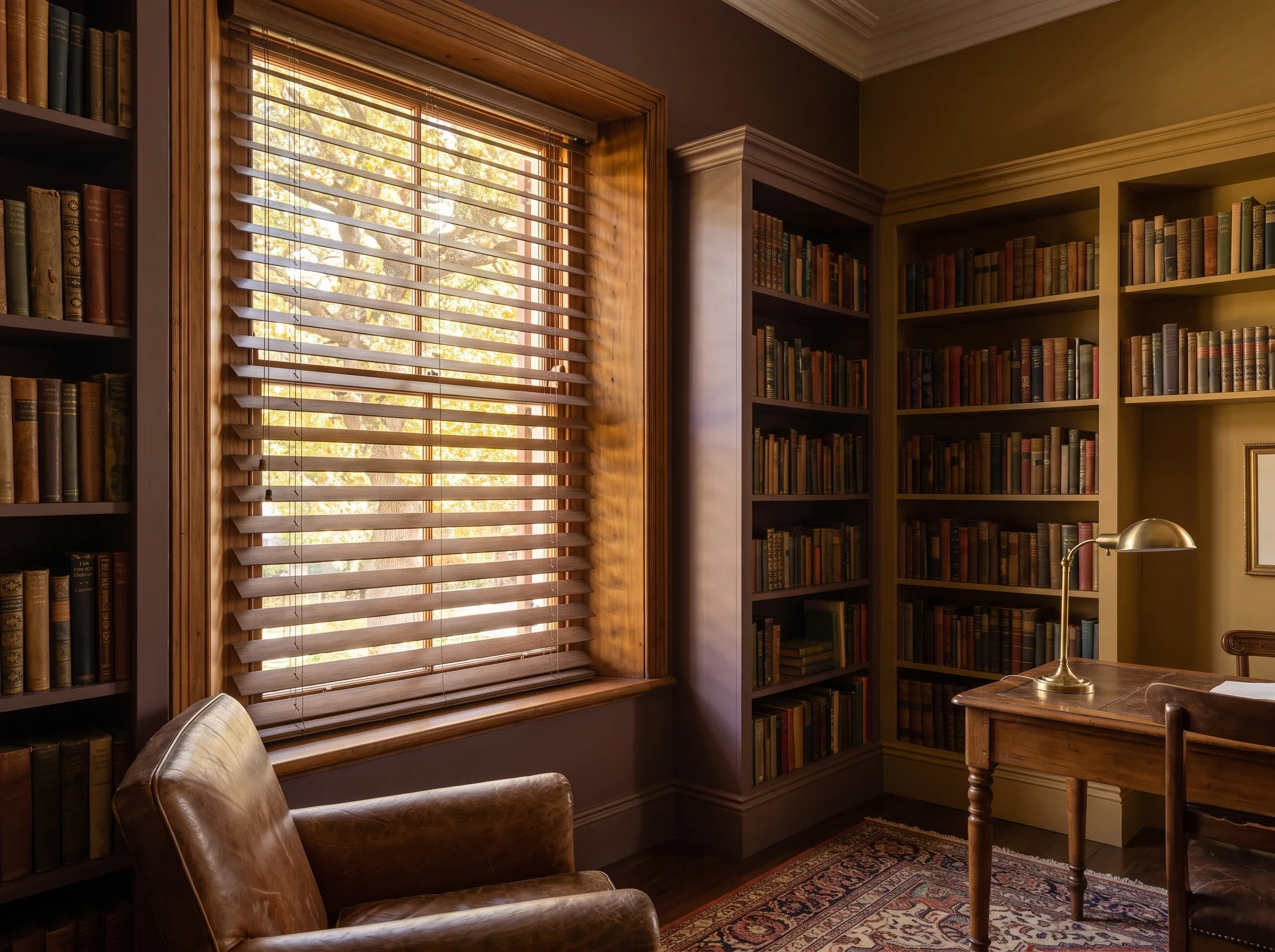
The reveal is the product here as much as the blind is — depth like this lets a slat blind sit fully inside the frame and leave the joinery on show.Lower sash
Sill to waist: the privacy half
Stand in the street outside an older Rondebosch semi and you will notice how little distance there is between the pavement and the front room. These houses were built before the motor car set the building line, so the front elevation often sits closer to the boundary than a modern house would dare. Everything a passer-by can see of your living room, they see through the bottom sash.
So the lower band of the window has one job, and it is not sun control. It is being able to sit in your own lounge at seven in the evening with the lights on. Three things decide how well that goes:
How much sill you want to keep
A deep Victorian sill board is furniture. If it currently holds plants, books, a radio or a cat, a blind fitted inside the reveal will drop in front of all of it and a blind fitted over the opening will hide the moulding. Neither is wrong; it is a decision, and it is easier made with the tape measure in the room than off a screen.
Whether the sash still slides
Plenty of original sashes in this suburb still run on their cords and weights, and the owners still open them. A blind fitted inside the reveal is generally happy with that, because the lower sash travels upward behind it. A catch, a stay or a security bar sticking into the reveal is the thing that catches people out — it needs clearance or the blind fouls it every time.
Cords, and children under about six
A long control chain reaching down to a low sill is exactly the height a small child can get at. Tensioners that anchor the chain to the frame are fitted as standard on our side, and where a room genuinely wants no loose cord at all, a wand-tilt or a motorised control removes the question rather than managing it.
Meeting rail
The rail where the two sashes cross
On a double-hung sash the two panels overlap at a single horizontal timber — the meeting rail. In these houses it usually lands somewhere around standing eye height, which means it sits well above the head of anybody sitting down. That is a more useful line than it sounds, because it separates the part of the window that owes you privacy from the part that owes you daylight.
Below the rail you are hiding. Above it you are harvesting. A blind that treats both halves identically is throwing away one of them.
Once you see the window in two bands, the product choice narrows quickly:
Day-night (zebra) blinds — alternating sheer and solid bands on a single roll. Nudge the chain and the bands slide out of register: solid over solid closes the window down, solid over sheer opens a view. It is the cheapest honest way to get a different answer top and bottom on one fitting.
A double roller — two fabrics, one bracket. A sunscreen mesh in front for the day, a blockout behind for the evening, both dropping into the same reveal. Two decisions on one window, and each one properly made.
Cellular blinds that open from the top — the fabric can be built to lower from the head as well as rise from the sill, so the bottom stays closed to the street while the head is dropped open to the sky. In a front room with a pavement two paces away, this is often the only arrangement that gives you both.
Be realistic about zebra bands
The band pitch on a day-night blind is fixed by the fabric, not by your window. You can align the open bands roughly where you want them, not surgically. If a room needs an exact split — clear glass above a precise line, nothing below it — the honest answer is two separate blinds on two separate brackets, and we will say so.
Upper sash
The upper sash, where the day gets in
Rondebosch sits at roughly 34 degrees south. Run that latitude against the tilt of the earth and the two extremes fall out without needing a specialist: at midsummer noon the sun stands close to 80 degrees above the horizon — very nearly overhead — and at midwinter noon it manages only about 32.1 The same arithmetic moves the sunset: in December the sun goes down at a bearing of roughly 241 degrees, south of due west, and in June at about 299, north of it.
Two practical facts follow, and both of them live in the top half of the window.
The first is that a summer noon sun at 80 degrees is almost falling straight down. Any decent overhang — the roof of an old veranda, a deep eave, a first-floor balcony — already shades a north-facing window at the hottest part of the day. Owners are often surprised that their north rooms are not the problem.
The second is that late summer afternoon light arrives at almost no height at all, on a bearing south of west, and it comes in under every overhang you own. It enters through the upper sash, crosses the room at seated eye level and lands on the far wall. No amount of blind on the bottom half of the window touches it. This is the single most common complaint we are called out to in this suburb, and it is a top-sash problem every time.
Glare and heat are two different jobs
For glare, a light sunscreen mesh on the room side is the right tool: it kills the hard beam, keeps the view and keeps the room bright. In Rondebosch's oak-shaded streets we usually specify a more open weave than a generic guide would, because the trees have already done part of the work and a dark mesh under a canopy makes a gloomy room.
For heat, an interior blind is working downstream of the problem. Sunlight passes through glass easily; once it has warmed the surfaces inside, that heat is much slower to get back out. Anything hung on the inside is intercepting energy that is already in the room. If the complaint is temperature rather than brightness, the answer is outside the glass — which is section six.
Winter turns the same band of window into an asset. A cellular blind — fabric folded into air-filled cells, where the trapped air does the insulating and the fabric merely holds it in shape — closed over the upper sash on a cold night keeps the room's warmth on your side of the pane. Rooms above a converted garage and rooms on the M3 side of the suburb feel it most, and the cells quieten traffic noise a little into the bargain.
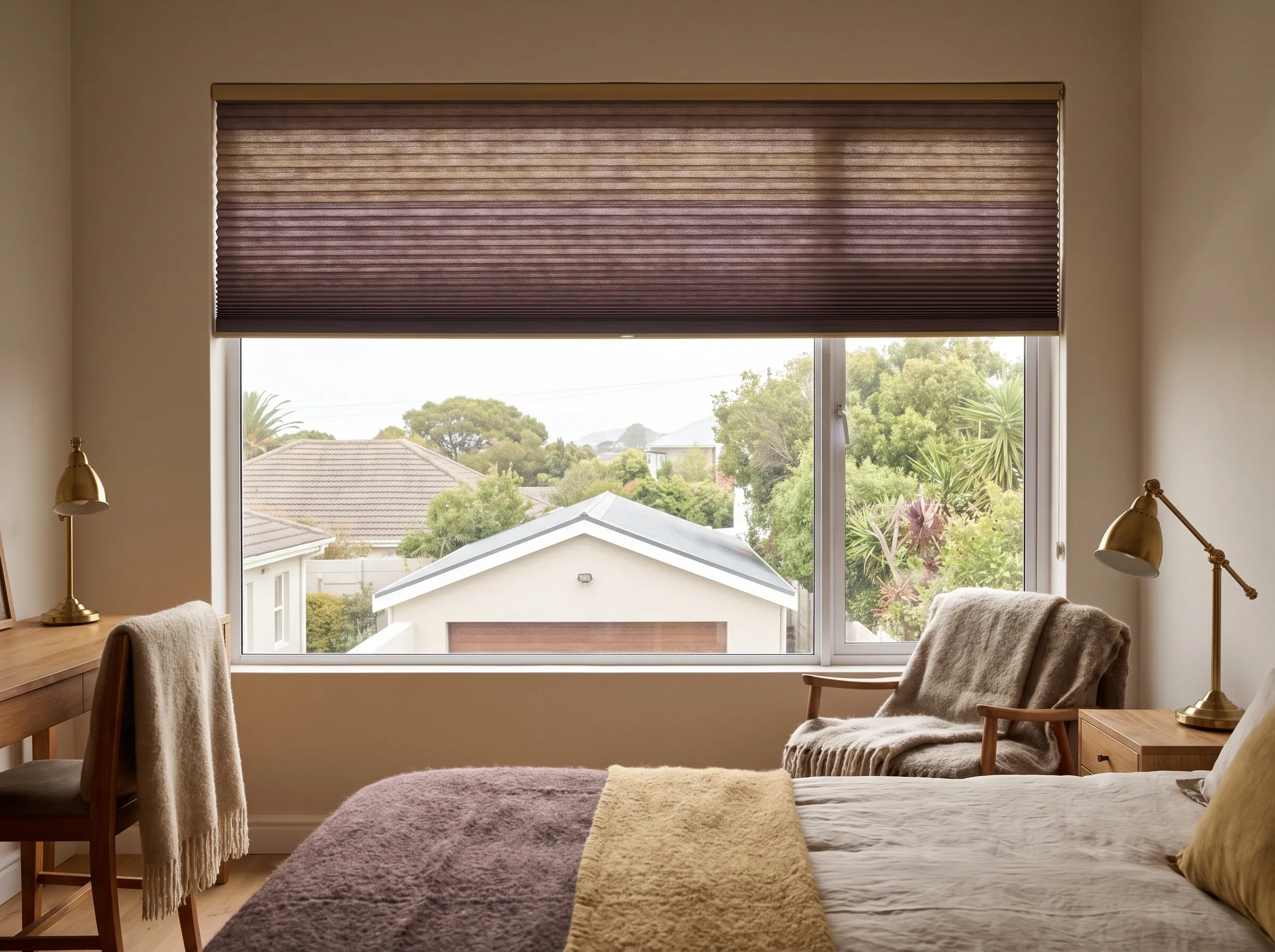
Closed across the top band, open across the bottom — the high sun and the high glare are handled without giving up the view or the daylight.Above the head
Fanlights, arches and a bay that is not a rectangle
Above the top sash, Rondebosch stops being tidy. Front doors carry fanlights. Some openings have segmental or round-arched heads. And the bay window — three facets, occasionally five, stepping out into the garden — is the feature people buy these houses for and the feature that defeats a standard bracket.
Arched and shaped heads
There are only two honest options and they trade against each other. You can have a blind cut to follow the curve, which looks right and is usually fixed or only partly operable, because a curved head has nowhere to roll into. Or you can square the opening off with a headbox mounted on the face above the arch, which operates perfectly and hides the shape you were trying to keep. We will show you both at the measure. There is no third answer, and anybody who tells you otherwise has not made one.
Bays
A bay is a set of separate windows that happen to touch, so it takes a separate blind per facet, meeting at the mullions. The join lines are visible and they should be — pretending a bay is one flat window is what produces the sagging, gaping results people photograph and send us. The facet angles are also rarely the textbook figure after a century of settlement, which is why each one is measured on its own rather than copied from the one beside it. Where a bay opens onto a wide sliding door instead, vertical vanes on a curved track can follow the shape in one run.
One facet dressed, the angled side lights left open — a bay is handled pane by pane, not as one wide rectangle.Outside
Past the frame: the wall, the veranda, the new back room
Everything so far has been on the room side of the glass. For heat, the better work happens outside it, and that is where the premium end of what we fit lives.
The external three
External venetian blinds. Aluminium slats carried in guides on the outside face of the building. They tilt as well as raise, so you can bounce the low western beam back out while keeping the garden in view, and in winter they lift entirely out of the way and give you every hour of sun back. On a hot west or north elevation this is the strongest thing we can offer.
Roller shutters. Rigid slats rolling down over the glass from a headbox. They shade hard in summer, and the still air held between slat and pane is useful on a cold night as well. On the M3 and Main Road edges of the suburb, owners often order them as much for the drop in road noise. To be plain: these are shading products for sun, heat and glare — not security-rated ones, which are a separate item.
Zip screens. Mesh running under tension in side channels, which is what lets it hold steady in wind that would fold an awning arm. The Victorian veranda is one of the best rooms in a Rondebosch house and it is unusable on a blustery summer afternoon; a zip screen on the open side is what turns it back into a room.
Two honest cautions. All three fix to the outside of the building, so they cost more and they raise the question below. And the south-easter that people associate with the coast reaches this far inland in summer2 — anything left outdoors here needs a real wind rating and, if it is retractable, a sensor that closes it before a gust rather than after.
The permission question, put simply
A blind inside the reveal changes nothing about the building. A guide channel, a headbox or an awning cassette bolted to the outside wall does. Under the National Heritage Resources Act, altering a structure — or any part of one — older than sixty years requires a permit from the provincial heritage resources authority, which in the Western Cape is Heritage Western Cape.3 A great many Rondebosch houses are comfortably past that age. We keep profiles slim, colours quiet and the paperwork complete, and where an external fixing is not going to happen on a street elevation, the honest second-best is a sunscreen mesh inside the glass — cheaper, and clearly weaker on heat.
Slats carried on the outside face, tilted to throw the beam back before it ever reaches the pane — and lifted right out of the way when the season turns.The map
Two Rondeboschs on one map
The suburb takes its name from the round thorn bush of the earliest Dutch farming post on this ground, and the Liesbeek still runs through it.4 But for shading purposes there are two Rondeboschs, and the fabric that is right in one is wrong in the other.
The mountain side runs up towards the slopes under an oak canopy planted long before anyone here was fitting blinds. Light arrives broken and green, and it changes completely between winter, when the oaks are bare, and midsummer, when they are not. A mesh chosen in July under bare branches will read much darker in January.
The Common side is the opposite. Rondebosch Common is a protected open space and a declared national heritage site, a surviving patch of Cape Flats sand fynbos kept deliberately open.5 Houses looking onto it have no canopy at all and a very wide sky. What they get is not so much a beam of sun as a flat, bright field of light off an overcast — the kind of glare that makes a screen unreadable at ten in the morning with no sun visible anywhere. That wants a different fabric from the oak streets: a slightly tighter weave, and often a slat blind that can be tilted to lift the light off the ceiling instead of blocking the window.
It is worth knowing which of the two you live in before you choose a colour. In practice most homes on this side of the suburb do best on a lighter, more open fabric than a generic calculator suggests, and most homes with an open sky in front of them do better a step tighter.
Before we arrive
A walk-round to do before we arrive
Nothing here needs a specialist and all of it makes your quote sharper. Take twenty minutes and a tape measure.
Find the meeting rail on each problem window and note whether it lands above or below your eye when you are sitting in the chair you actually use. That is where the split belongs.
Measure the reveal depth twice — once at the sill, once at the head. If the two numbers differ, tell us; it changes the bracket, not the price.
Open every sash you intend to keep using and look for catches, stays and burglar bars sitting proud in the reveal. Those decide inside-fit against face-fit.
Watch one January afternoon in the room that overheats, and note the hour the sun first reaches the far wall. That timestamp tells us more than any calculation.
Look for a plug point near each window you would like motorised, and note the ones with nothing in reach. Battery tubes solve it, but they need to be rechargeable without a ladder.
Walk to the pavement and look back at any elevation where you are considering something fixed outside. If it shows from the street on an older house, that is a conversation to have first, not later.
That is the honest reason the measure is free and unhurried. Every one of these is cheaper to discover before a quote than after a fitting.
Next step
Book your free in-home measure
Tell us which windows are the difficult ones — the bay nobody has managed to dress, the west room that cooks in February, the front sash you cannot sit behind after dark. One of our expert consultants will contact you shortly to arrange a free measure and a written per-window quote.
Every reveal measured at head and sill, not assumed to a standard bracket
Fabric and slat samples held against your own glass, in your own light
Written, itemised quote before anything is ordered
Sources
What we checked, and where
The sun figures in section four are ordinary arithmetic from Rondebosch's latitude and the tilt of the earth, and we have said so rather than dressing them up as a survey; the published tables agree with them closely. The observations about window proportions, reveal depths and fabric choice are our own working opinion from measuring in this suburb, offered free and without obligation. Nothing on this page is a heritage-approval opinion — that belongs to Heritage Western Cape and the City of Cape Town.
timeanddate.com — Sun and daylight tables for Cape Town (published solar altitude and sunrise/sunset bearings against which our latitude arithmetic can be checked).
Wikipedia — The Cape Doctor (the dry south-easterly wind of the Cape Peninsula, blowing through the summer months from around spring to early autumn).
SAFLII — National Heritage Resources Act 25 of 1999, section 34 (no person may alter or demolish any structure, or part of a structure, older than 60 years without a permit from the provincial heritage resources authority).
Wikipedia — Rondebosch (the name derives from the early Dutch "round bush" outpost on this ground; the Liesbeek river runs through the suburb).
Wikipedia — Rondebosch Common (a protected open space and declared heritage site conserving a remnant of Cape Flats sand fynbos).