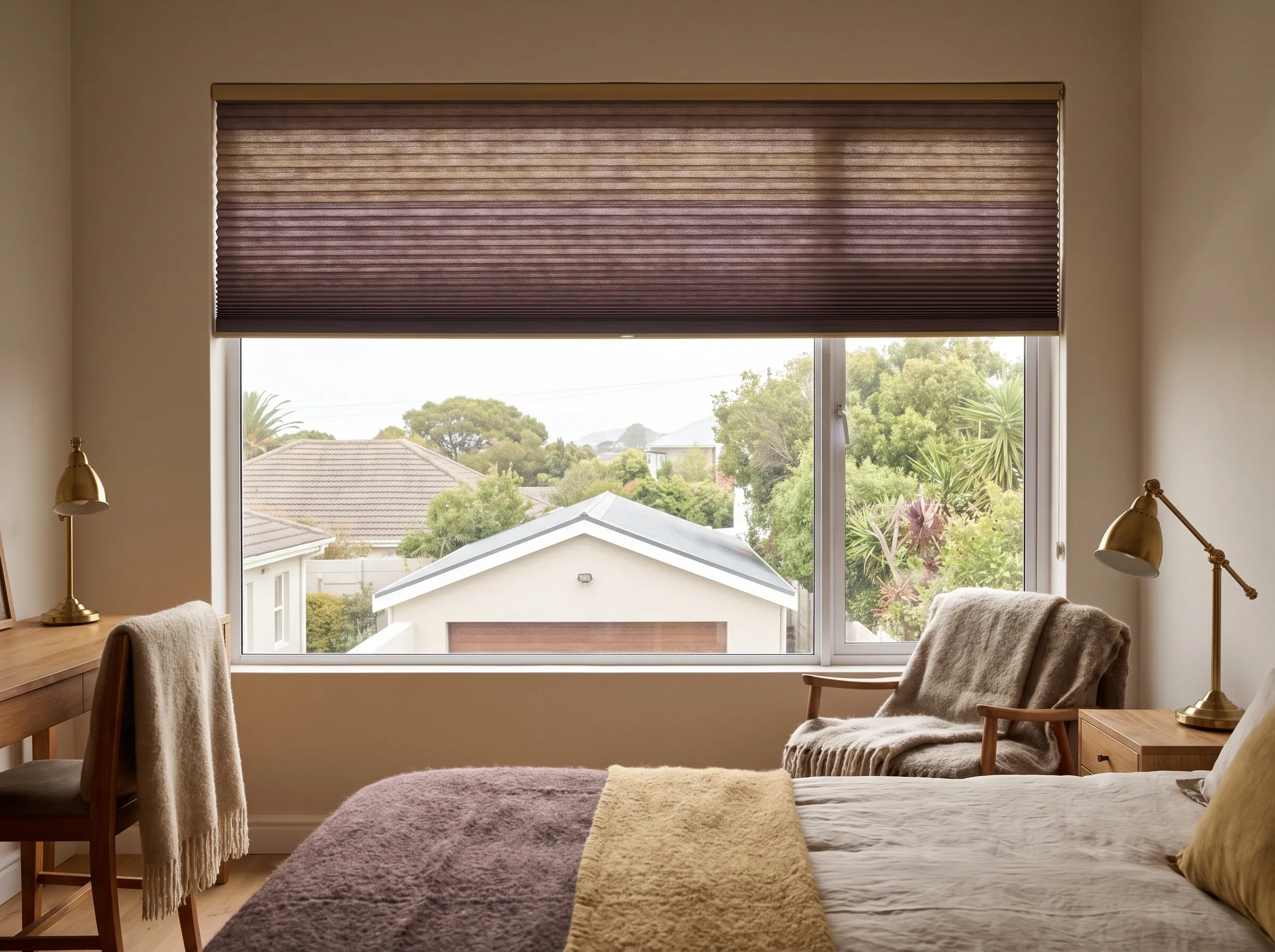
Trapped air, working two ways
The pleated fabric folds into hexagonal cells rather than lying flat, and each cell traps a still layer of air against the glass. That trapped air is the entire mechanism — a soft thermal buffer that takes the edge off a cold room in winter and a hot one in summer, and, as a side effect of the same cell structure, absorbs some of the sound that would otherwise pass straight through a single pane. We keep the claim qualitative rather than inventing a percentage: noticeably more comfortable, not a lab result.
Where it earns its keep in Rondebosch
Two briefs come up on repeat here. The first is the room above a garage conversion or a rear extension — usually the coldest room in the house, because it has less thermal mass around it than the original build. The second is anything backing onto De Waal Drive, where the road noise off the mountain's eastern slope is real and constant; a cellular blind won't replace double glazing, but the cell structure measurably softens a bedroom or a study on that side of the house. Both briefs point to the same product for different reasons.
Top-down, bottom-up, and the street-facing case
Rondebosch has plenty of ground-floor windows sitting close to the pavement — old villas set near the boundary wall rather than set back behind a long garden. A top-down/bottom-up cellular blind covers the bottom half for privacy from the street while leaving the top open to light and the oak canopy above, which suits a front room better than a blind that's fully up or fully down.
It's the product we reach for most often on Newlands' upper, forest-shaded slopes, where the same trapped-air cell buffers a cold, damp room as readily as a hot one, and again on the larger glazed extensions going up in Bishopscourt, where damp, lower-light interiors are the more common brief than glare.
It's usually the coldest room in the house that gets a cellular blind — the one above the garage, or the one that picked up an extra wall of single glazing when the extension went up.
On-site measure, Rondebosch- Single or double cell construction — double cell for serious thermal work
- Light-filtering or blockout cell fabric
- Top-down/bottom-up operation for street-facing windows
- Cordless or motorised — the smallest stack of any blind when raised
- Also made for skylight and shaped openings — the cells hold their shape on an angle
What a cellular blind costs
Cellular blinds cost more than a flat fabric on a tube because the honeycomb is insulating as well as shading, which is worth real money in a high-ceilinged room with single glazing. The installed figures per square metre are R1,500 to R2,800 with a cord or a cordless lift, and R3,000 to R4,800 once a motor is in it. Double cells, blockout linings and top-down-bottom-up head rails sit at the upper end of each band.
Narrow openings carry a minimum charge, since the head rail and the fitting visit are the same work at any width. The bands are for planning; the figure per window comes out of the free measure and is confirmed in writing before manufacture.
Cold room, or a De Waal Drive-facing wall?
Free measure in your own rooms, then a written price for each opening. No obligation to go ahead.