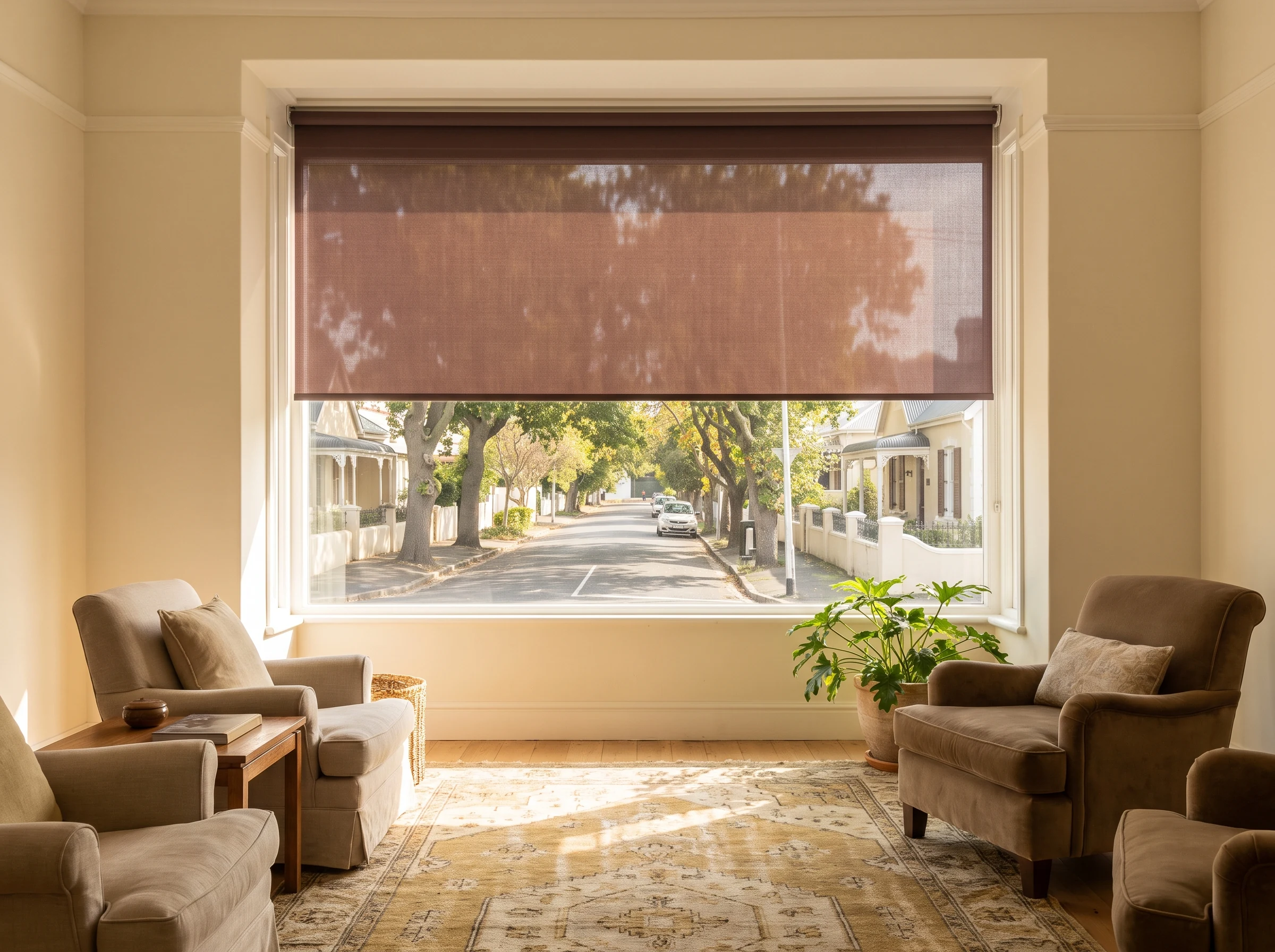
Sunscreen for oak-filtered light, not glare off tar
On an open street, a 3% sunscreen is the usual pick for cutting the last, hardest hour of afternoon sun. Under Rondebosch's oak canopy the same fabric can read noticeably darker by mid-afternoon, since the light reaching the mesh is already broken up by the leaves overhead. Most of our Rondebosch measures land on a 5%, sometimes a 10%, openness on tree-shaded elevations — enough to soften the low sun without turning a bay window gloomy at three in the afternoon in July.
Blockout, and the double-roller answer for early mornings
A school-day household usually wants one thing a sunscreen can't give: proper dark on a winter morning that doesn't clash with a 6:30am alarm. A single blockout roller handles that on its own. A double roller (day/night) pairs a blockout fabric with a sunscreen on the same bracket, so a child's room gets filtered daylight through the afternoon and total dark once the blind comes down at bedtime — no swapping blinds, no compromise either way.
Fitted to a reveal that's rarely square
A hundred years of settling leaves plenty of Rondebosch sash and bay frames slightly out of true, even when they look fine from across the room. Chain and cord tensioners are fitted as standard on anything corded, and we favour a face-fixed cassette over a tight inside-mount bracket wherever the reveal is shallow or uneven — it sits cleaner than forcing a track into a frame it wasn't built for. Wide bay windows either split with a central join line or run as motorised linked blinds, so no single chain is doing the work of three metres of fabric.
The right mesh openness moves with the street, not just the window. The same 3% that reads correctly on Kenilworth's open, unshaded frontages needs recalibrating a few kilometres over — Claremont's Main Road apartments take direct sun through full-height balcony glazing for most of the day, which is usually where we add motorisation rather than leaving a hand chain to do the work.
The bay window is nearly always the one that gets measured twice — once for the width, once for how far out of square a century has pushed it.
On-site measure, Rondebosch- Sunscreen mesh, 3%, 5% or 10% openness
- Blockout fabric for bedrooms and early school mornings
- Double roller (day/night) on one bracket
- Chain, spring or motorised control
- Face-fixed cassette option for shallow or uneven reveals
What a roller blind costs here
Rollers are quoted per square metre, installed, and the fabric and the control set the figure. Manual, on a chain or spring, in sunscreen, blockout or a light-filtering weave: R1,000 to R1,600 the square metre, with a double roller on one bracket near the top of that band. Motorised, the same opening comes to R2,500 to R3,800 — motor, control and commissioning included.
A narrow window is charged at a minimum rather than by its area, because a scullery pane takes the same tube, brackets and fitting time as a bay. A bay itself is measured twice and quoted as the sections it actually splits into. None of these bands is a quotation: your own numbers come out of the free measure, in writing.
Ready to measure your windows?
A free measure at the house, then every window priced in writing before you commit.